

The Influence Machine
$140 million in PAC money. Most of it unspent.

In April 2026, a marketing agency called SM4 began pitching lifestyle influencers on TikTok and Instagram a deal: $5,000 per video to talk about China and AI. The brief, provided by a nonprofit called Build American AI, included sample scripts about China stealing American jobs. One ended: "In the AI innovation race, I'm Team USA!!!"
The influencers were specifically chosen for having "left-of-center" audiences — "left-leaning female lifestyle and family" content. The funding was not disclosed. When WIRED's Taylor Lorenz contacted Build American AI for comment, the response came from a Republican operative.
The audience would see a lifestyle creator sharing a personal opinion. They would not see who paid for it.
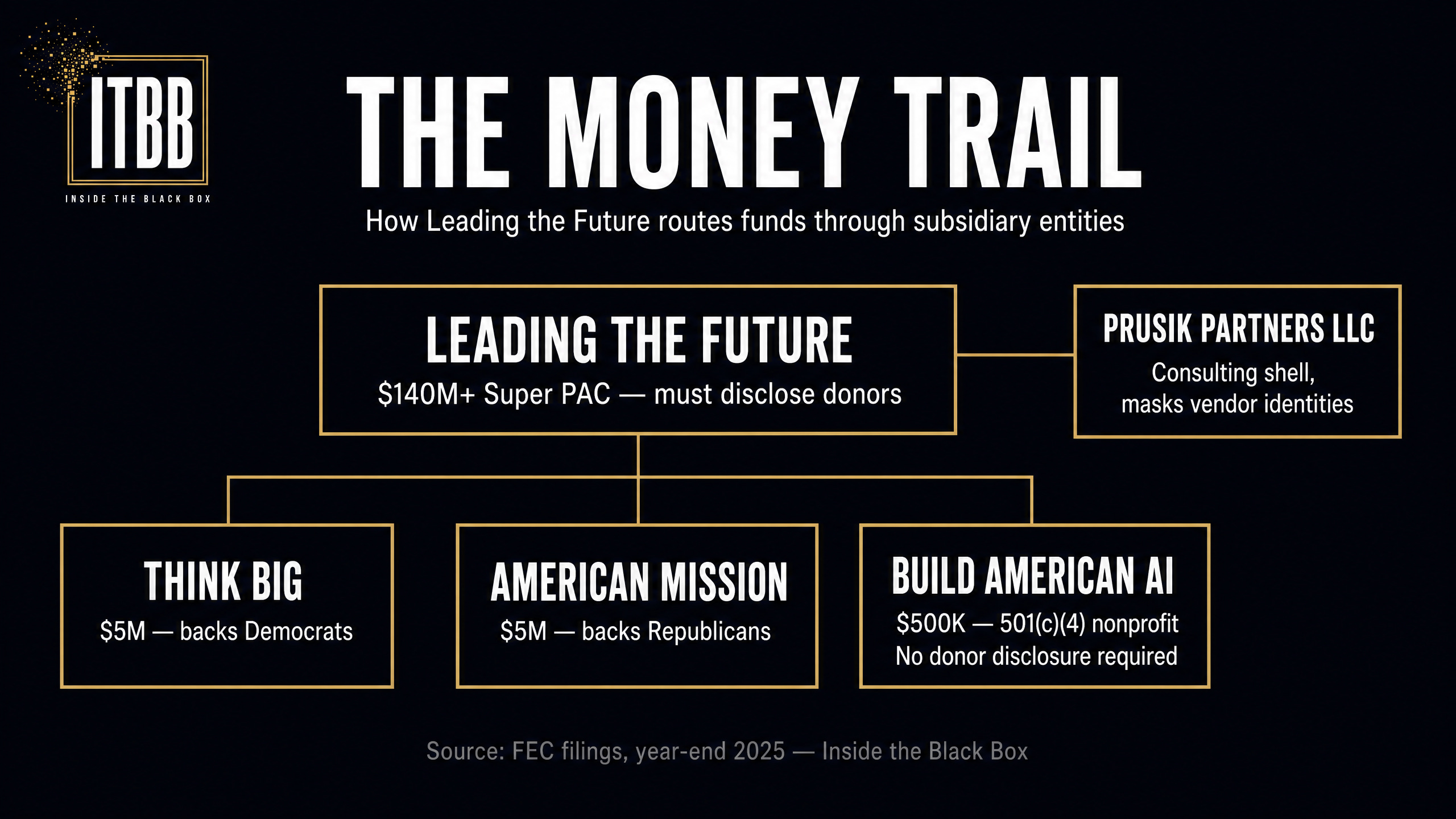
Build American AI is an affiliated nonprofit funded by Leading the Future, a super PAC that has raised more than $140 million in total contributions and commitments from a group of AI executives and investors: OpenAI president Greg Brockman, Palantir co-founder Joe Lonsdale, and venture capitalists Marc Andreessen, Ben Horowitz, and Ron Conway. Its stated purpose is to support candidates who favor "innovation-friendly" AI policy. In practice, its money flows toward candidates and campaigns opposing enforceable AI safety rules.
Two weeks before the influencer campaign was exposed, Tyler Johnston at Model Republic published a more significant finding. A site called The Wire by Acutus had published 94 articles since late December 2025, with no masthead, no named editors, and no disclosed ownership. AI content detection flagged 69% of the articles as entirely machine-generated.
The site's source code exposed an internal editorial pipeline: a "Generate Story Draft" button and an "AI interviewer" that sent emails under fake bylines. Nathan Calvin, general counsel of the AI safety group Encode, received one of these fake interview requests. OpenAI would later serve him with a subpoena. More than a third of the articles read like paid advocacy, and Johnston traced the site's operation to political consulting firms connected to Leading the Future's network.
The influencer campaign and the synthetic newsroom targeted different audiences — voters in one case, advocacy organizations in the other — but both traced back to the same PAC infrastructure. Together they reveal the machine's purpose: make AI regulation politically expensive before the fights formally begin.
The Money Trail
Leading the Future is a super PAC — it must disclose its donors and spending. But it routes money through subsidiaries and a dark-money nonprofit, Build American AI, that can spend unlimited amounts on issue ads and influencer campaigns without naming its donors. No single filing tells the whole story.
The Playbook
Chris Lehane, a longtime Democratic operative, built the crypto industry's political machine as a board member at Coinbase: super PAC, dark money nonprofit, scorecards, and overwhelming force against anyone who resisted. "If you are even slightly critical of us, we won't just kill you — we'll kill your fucking family, we'll end your career," one political operative told The New Yorker.
The crypto operation made its industry the single largest political spender in the 2024 general election. Then Lehane moved to OpenAI.
He joined OpenAI as chief global affairs officer in August 2024. Before Lehane, OpenAI's CEO told a Senate committee that AI companies above a certain capability threshold should require a license. By early 2025, that position had vanished from OpenAI's public advocacy.
By August 2025, Leading the Future launched, "created with Lehane's input and modeled after the pro-crypto PAC he started," according to Transformer News. The structure followed the crypto template closely. OpenAI told Transformer News that Lehane is not involved with the PAC's legal strategy; the PAC did not respond to Transformer's requests for comment.
Making an Example
The first demonstration was Alex Bores.
Bores is a New York state assemblymember who authored the RAISE Act, one of the first state-level AI safety bills to pass in the United States. In late 2025, he announced a run for Congress. An analysis on LessWrong reported that Leading the Future declared him their primary target more than a year before the election — not necessarily to defeat him, but to "make an example" of him. The message to other elected officials: pro-safety positions carry a political cost.
The same analysis cited AI policy contacts in D.C. saying the strategy was working — that members of Congress are being advised not to take pro-safety positions.
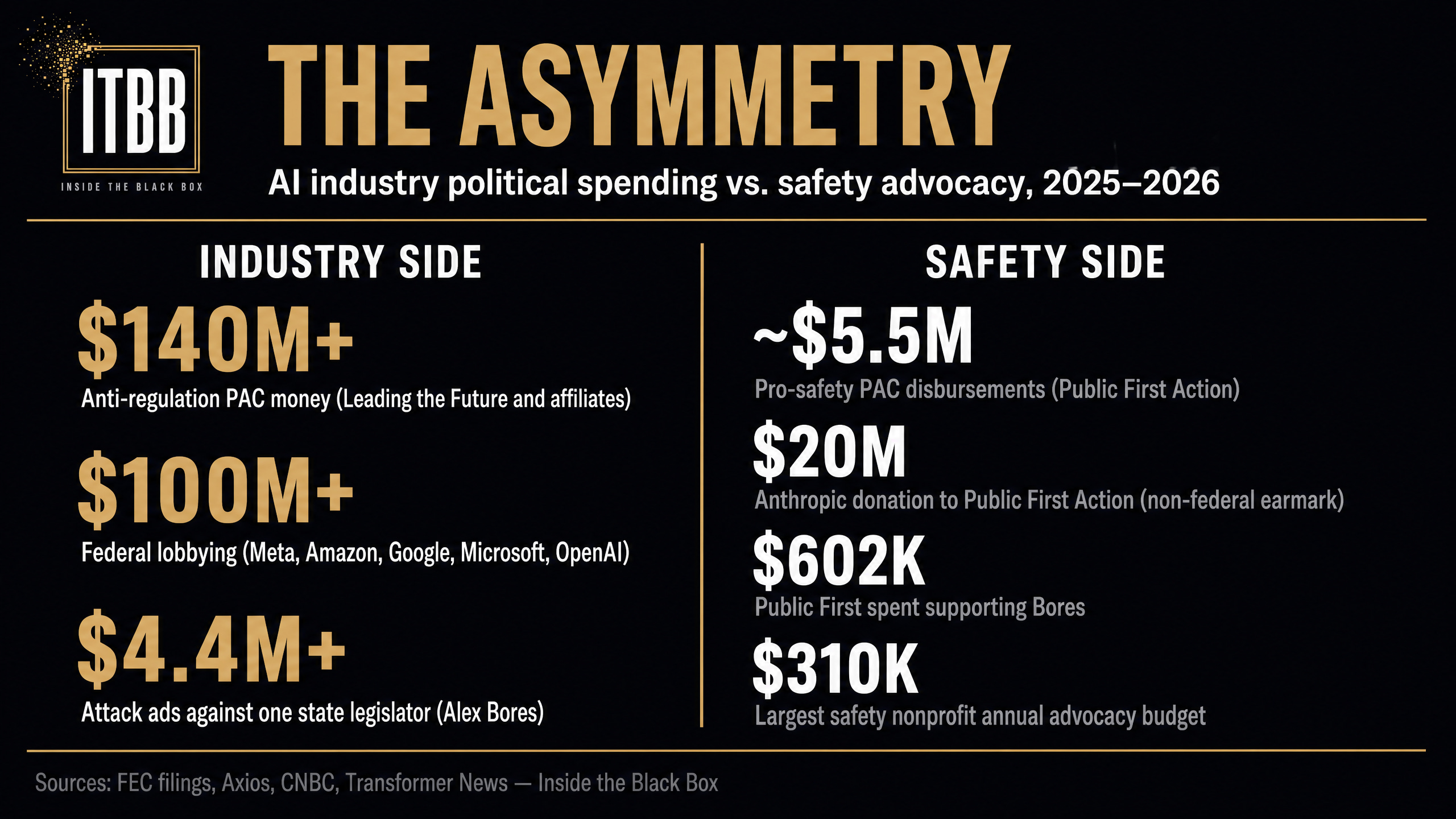
Think Big, one of LTF's subsidiary PACs, has spent more than $4.4 million targeting Bores, according to FEC independent expenditure filings. The ads accused him of "enabling ICE and powering their deportations" because he previously worked at Palantir. The attack was funded by a PAC network backed in part by Palantir co-founder Joe Lonsdale.
Against this, the safety side has spent $602,208 supporting Bores through Public First Action (itself a dark money nonprofit, funded in part by Anthropic's $20 million).
In a March 2026 Quinnipiac poll, 55% of Americans said AI will do "more harm than good" — up from 44% a year earlier. The crypto playbook Lehane imported assumed a low-salience issue, voters who didn't care enough to push back. AI may not be that issue.
The Asymmetry
Most of Leading the Future's $140 million remains unspent — a standing threat available for deployment against any candidate who becomes inconvenient.
Technology companies with major AI operations spent over $100 million lobbying the federal government in 2025, the first time the industry crossed that threshold. The safety side's total disclosed PAC disbursements: roughly $5.5 million. IBM's Christopher Padilla, the company's chief lobbyist: "IBM lobbyists have simply outmaneuvered the 'AI safety' lobby, which has fewer ties in the nation's capital and less familiarity with how Washington works."
Even the safety-side spending is not straightforward. Public First Action, the main pro-safety PAC operation, is itself a 501(c)(4) that doesn't disclose all its donors. Its only confirmed major funder is Anthropic, whose $20 million was explicitly earmarked as money that "cannot be used to influence federal elections." At least $5.5 million funneled from Public First Action to super PACs came from undisclosed donors. A Transformer News investigation noted the irony: an organization that lists "Accountability and Transparency" as its top AI policy issue operates as a dark money vehicle.
What's Left
During its restructuring from a nonprofit to a for-profit company, OpenAI served subpoenas to leaders of advocacy organizations that opposed the change. A sheriff's deputy delivered one to the home of Encode's Nathan Calvin — the same person targeted by a fake interview request from The Wire by Acutus months earlier. The subpoena demanded all documents related to Calvin's communications with Elon Musk, including regarding AI safety legislation that Encode supported.
"Their point is: We are going to make this litigation hell for you," said Jay Edelson, the attorney representing a family suing OpenAI in a separate case. Calvin described the experience as "the most stressful period of my professional life."
OpenAI told Transformer that its legal team, not Lehane, handles legal discovery, and described the subpoenas as "a routine step in litigation."
In May 2026, OpenAI began publicly distancing itself from Leading the Future — the infrastructure its own chief global affairs officer helped design. But political machines outlast the names on the filings. Vote for enforceable AI testing, and the money finds your district. Organize or testify at the wrong moment, and discovery arrives at your house. By the time a federal AI bill reaches a committee, the warning has already been delivered.
Next in this series: Three Calls Killed America’s Latest AI Safety Order — what the political operation produced: a regulatory framework the industry authored itself.
If you want to read the first first piece of the series on AI Safety start here:
What Dario Amodei Means by "Safety"

Dario Amodei told Axios there's a 25% chance that AI goes catastrophically wrong.